
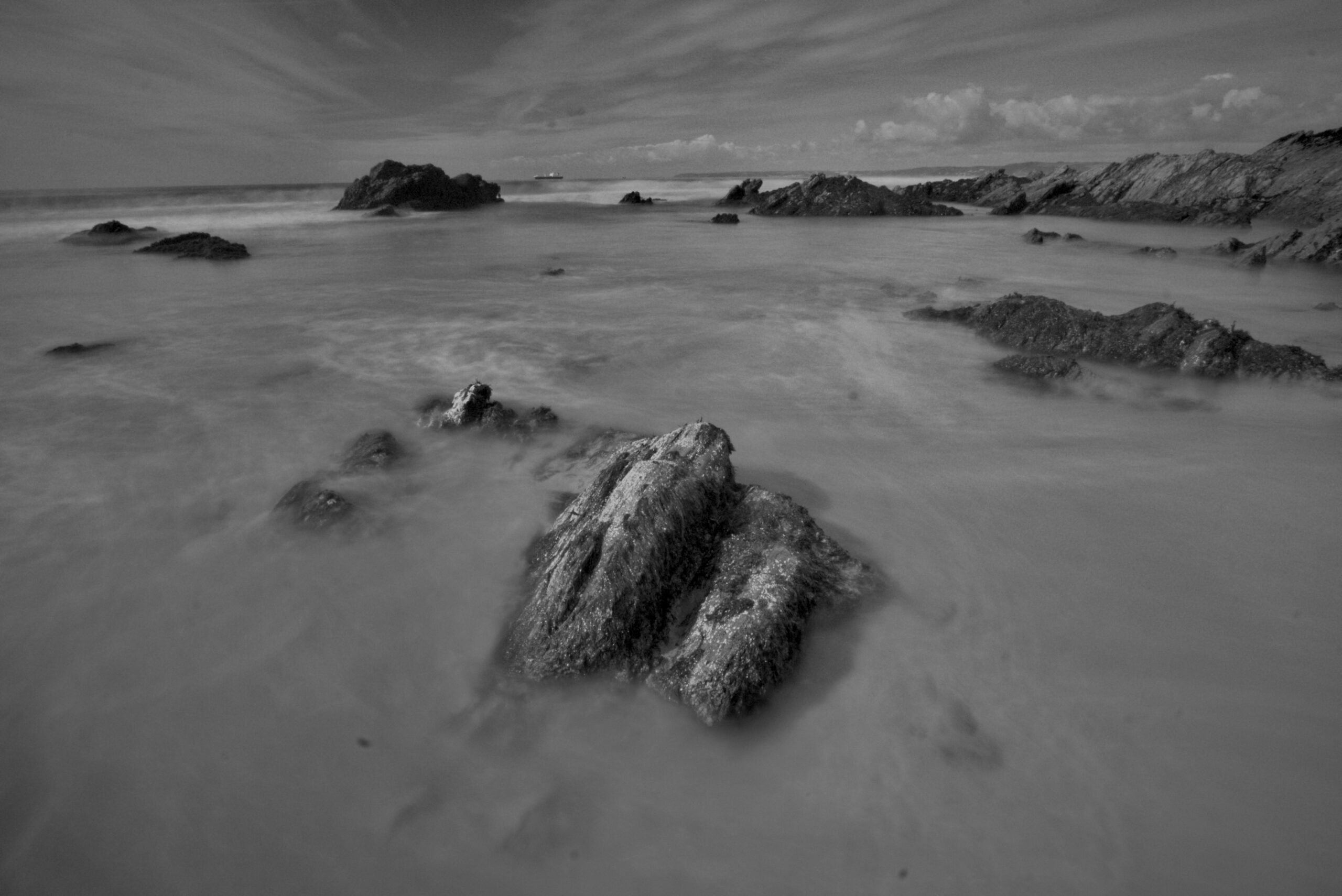

I recently found myself back at Whitsand Bay, somewhere familiar enough that I already had a sense of what to expect. The beach, the cliffs, the rocks and the sea were not new to me. But I went there with a different intention: to slow everything down and see what would happen when I photographed the landscape through long exposure.
I wanted to compare what I saw with my eyes to what I eventually captured with my camera.
At first, it seemed like a simple exercise in photography. The tide was low, revealing areas of the beach that are hidden beneath the water at other times. Rockpools appeared between the rocks, reflecting fragments of the sky. Barnacles clung to exposed surfaces, while seaweed lay across the rocks, left behind by the retreating water.
But standing there, the landscape felt anything but still.
There was the constant noise of the waves, sometimes gentle and rhythmic, sometimes suddenly much louder as a larger wave reached the shore. Water moved around my feet and between the rocks. Seaweed shifted with the remaining currents. The tide was slowly changing the shape of the beach, even though the movement was almost imperceptible from one moment to the next.
This sense of movement became one of the things I wanted to explore through the photographs.
Long exposure photography has an interesting way of changing our understanding of time. The camera records movement differently from the human eye. Waves that I experienced as energetic and unpredictable could become smooth areas of white water. The constant motion of the sea could appear almost tranquil. What sounded loud and powerful while I was standing there became silent in the photograph.
In that sense, the photograph isn't necessarily a record of exactly what I saw.
It is a record of time.
The passage of the tide
The tide became an important part of the experience. At low tide, the beach seemed to reveal another version of itself. Surfaces that are normally underwater became visible, exposing the smaller details of the landscape: rockpools, barnacles, seaweed and channels carved into the sand.
These details made me think about transience.
The scene in front of me was temporary. The rockpools would eventually change or disappear beneath the incoming tide. The seaweed would be moved again. Footprints would be washed away. The patterns in the sand would be replaced.
Even the horizon seemed to represent this idea of constant change. It remained visually stable, but everything beneath it was moving.
The photographs became a way of holding onto a moment that was, by its nature, impossible to hold.
Erosion and time
Whitsand Bay also made me think about erosion.
The cliffs and rocks carry evidence of much longer periods of movement than I could possibly experience in one visit. The waves I was photographing are part of a process that has been happening repeatedly, day after day, year after year.
There is something quite humbling about considering that while I was waiting for a thirty-second exposure, the landscape was undergoing its own much slower transformation.
My camera was measuring seconds.
The coastline was measuring centuries.
That contrast made me look differently at the rocks around me. Barnacles attached themselves to surfaces shaped by the sea, while seaweed occupied the spaces between land and water. Rockpools became temporary pockets of ocean, existing only until the tide returned.
Everything seemed to be somewhere between arrival and departure.
Drift
There was also something about drift that stayed with me.
Seaweed drifting in the water. Water drifting across the sand. Clouds moving above the horizon. The slow movement of the tide. Even the camera itself introduced a kind of interpretation, transforming all of this movement into something softer and less recognisable.
Long exposure can make movement look almost weightless.
The waves lose their individual identities. Instead of seeing one wave followed by another, I began to see a continuous passage of water. The photograph compresses all those separate moments into a single image.
Perhaps this is why the resulting photographs felt different from the experience of being there.
When I was standing on the beach, I experienced movement as something immediate.
When I looked at the photographs afterwards, I experienced movement as something remembered.
What I saw, and what the camera saw
This was ultimately what I was interested in when I returned to somewhere familiar.
I wasn't simply trying to photograph Whitsand Bay as it looked.
I wanted to discover how differently I could see it.
The camera removed some of the things that made the experience so immediate—the noise of the waves, the changing temperature, the wind, the smell of the sea and the awareness that the tide was constantly moving.
In their place, the long exposures gave me something quieter.
The sea became smoother. Movement became blurred. The horizon became more pronounced. Details such as barnacles and seaweed became small reminders of the physical landscape beneath the larger, more atmospheric image.
And perhaps that is the most interesting thing about photography.
A photograph doesn't necessarily preserve an experience exactly as it happened. Instead, it creates another version of it.
Standing at Whitsand Bay, I experienced the sea as movement, sound and change.
Looking back at the photographs, I see stillness.
Both are true.
The beach I visited was only one moment in the much longer passage of the tide, and the photographs are only one interpretation of that moment.
The waves have continued moving. The tide has continued coming and going. The rocks continue to erode. Seaweed continues to drift.
And somewhere between all of that movement and stillness is the photograph.