
Things the Sea Forgot to Take
Photographing Ayrmer Cove
The sea is very good at taking things. It takes sand from one place and puts it somewhere else, rearranges seaweed as though it has become bored with its previous arrangement, and occasionally throws things onto the beach that look as if they belong to another world entirely. It is rather like a housekeeper who doesn't believe in putting anything back where it found it.
But sometimes, I think, the sea forgets things.
That was the thought that followed me around Ayrmer Cove, a camera in my hands and the wind doing its best to convince me that photography would be much easier if I had six hands instead of two.
A Cove with a Rather Uncooperative Sky
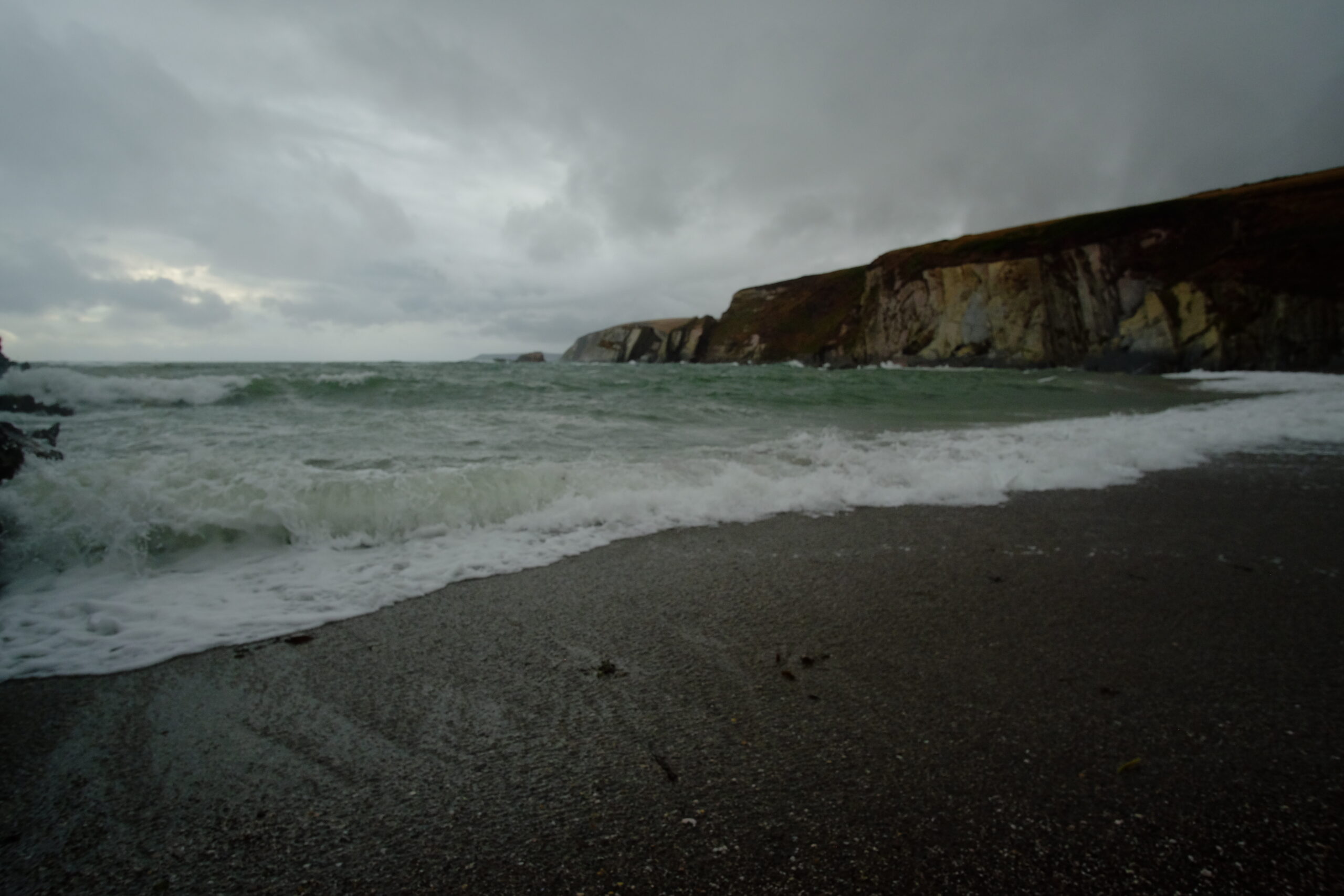
Ayrmer Cove was supposed to be a research trip. I had gone looking for photographic possibilities, particularly the dramatic waves crashing against the cliffs, and for somewhere close enough to Burgh Island to enjoy the surrounding coastline without being quite so close to the island itself.
The weather, however, had other ideas.
There was no sunshine. The sky was cloudy, the wind was persistent, and the sea was making an extraordinary amount of noise. I had chosen low tide because I wanted to explore the beach, which was a sensible decision, although the weather seemed to regard my sensible decisions as a personal challenge.
Getting down from the car park was a short walk. That was the easy part.
The difficult part was accepting that a place can have enormous photographic potential and still refuse to cooperate on the particular day you visit it. There were waves, rocks, cliffs and all the ingredients one might reasonably ask for. What there wasn't was the sort of light that makes a photographer want to dance about with excitement.
I didn't dance. The wind would probably have carried me away.
Still, I had come to look, and looking is a perfectly respectable thing to do even when the photographs don't turn out quite as you imagined. A location doesn't owe you a beautiful sunset just because you've brought a camera.
I think it's important to remember that.
The Cliffs Will Not Miss Me
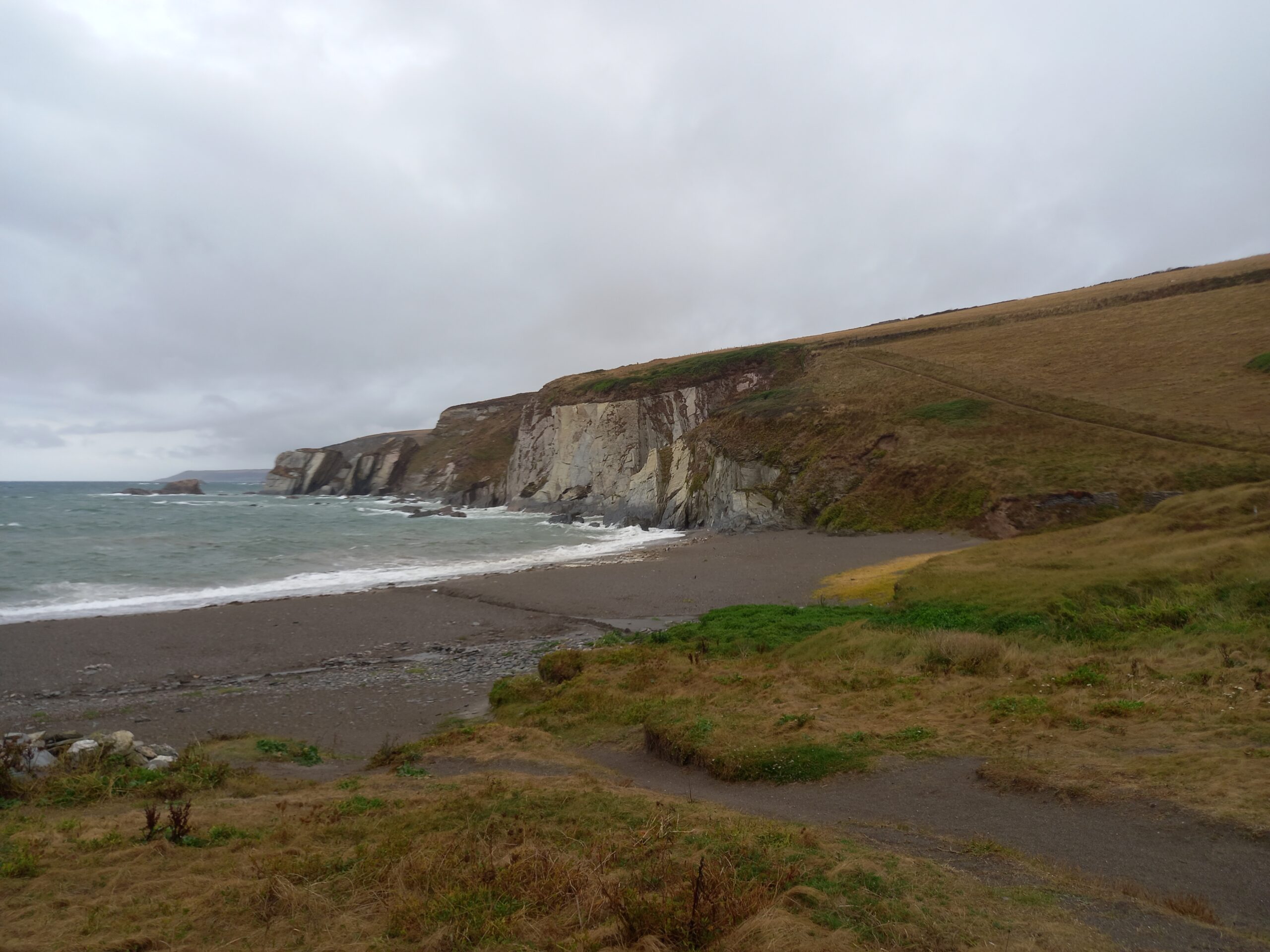
The first thing I noticed was the cliffs.
They stood above the water with the sort of indifference that is either very reassuring or slightly insulting, depending on your mood. The waves battered against them, sending water into the air, while the cliffs continued to exist as if this was something they had experienced rather a lot of times before.
Which, of course, they had.
I found myself thinking about how long they would remain there after I was gone. Not simply after I had walked back to the car park, but after I had stopped existing altogether.
It is a strange thing to consider while standing on a beach with cold hands and a camera, but the thought didn't make me unhappy. There was something comforting about it.
We spend so much of our lives worrying about the things that happen to us. We worry about what people think, whether we've accomplished enough, and whether the things we make will be remembered. The cliffs, meanwhile, have no apparent interest in any of this. They have survived countless tides and storms without once asking whether anyone has appreciated them properly.
They will continue to change, of course. Rock wears away. Water finds weaknesses. Even the largest cliffs are not permanent in the way we sometimes imagine permanence to be. But their timescale is so different from ours that trying to compare the two seems a little like comparing the lifespan of a starfish to that of a passing cloud.
Perhaps that is why I wanted to photograph them.
A photograph cannot make something immortal, however much we might wish it could. It can preserve a particular moment, a particular arrangement of light and water and stone. It can give us something to return to when the original scene has changed beyond recognition.
The cliffs will not know that I was there.
I find that rather lovely.
The Seaweed Has Its Own Plans
The cliffs were not the only things that caught my attention.
There was the seaweed, for instance.
I have always found the way seaweed is arranged along a beach rather interesting. Sometimes it lies scattered across the sand, as though someone has emptied a very untidy basket. Sometimes it gathers among the rocks, caught in little crevices and hollows. And sometimes it seems to have disappeared altogether, only to return in a different place after the next tide.
It is easy to look at seaweed and see nothing more than something slimy that gets in the way of a pleasant walk.
This is probably unfair to seaweed.
The tide is constantly moving it, shifting it from one part of the shore to another. What appears settled in the morning may be somewhere entirely different by the afternoon. It has no say in the matter, at least not in any way we would recognise, and yet it continues to be part of the beach.
I began to think that this was rather like life.
We make arrangements. We decide where we belong, where we would like to go, and what we imagine our lives should look like. Then something comes along and moves everything about. Sometimes it is a small change. Sometimes it is a great crashing wave that leaves us wondering whether we have accidentally wandered into the wrong story.
We don't always get to choose where we end up.
But perhaps there is something to be said for learning to exist wherever the tide leaves us, even if we would have preferred somewhere drier.
The seaweed certainly doesn't seem to waste much time complaining. Then again, perhaps it complains in a language I haven't learnt yet. I wouldn't want to be presumptuous.
I found myself looking at the beach differently after that. Instead of seeing scattered debris, I began to see traces of movement. The sea had been here, and here, and here again. Every little strand was evidence of something that had happened beyond the moment I could see.
A beach is not a still life. It is a record of constant rearrangement.
And that, I thought, was worth paying attention to.
A Very Small Plant with a Very Stubborn Life
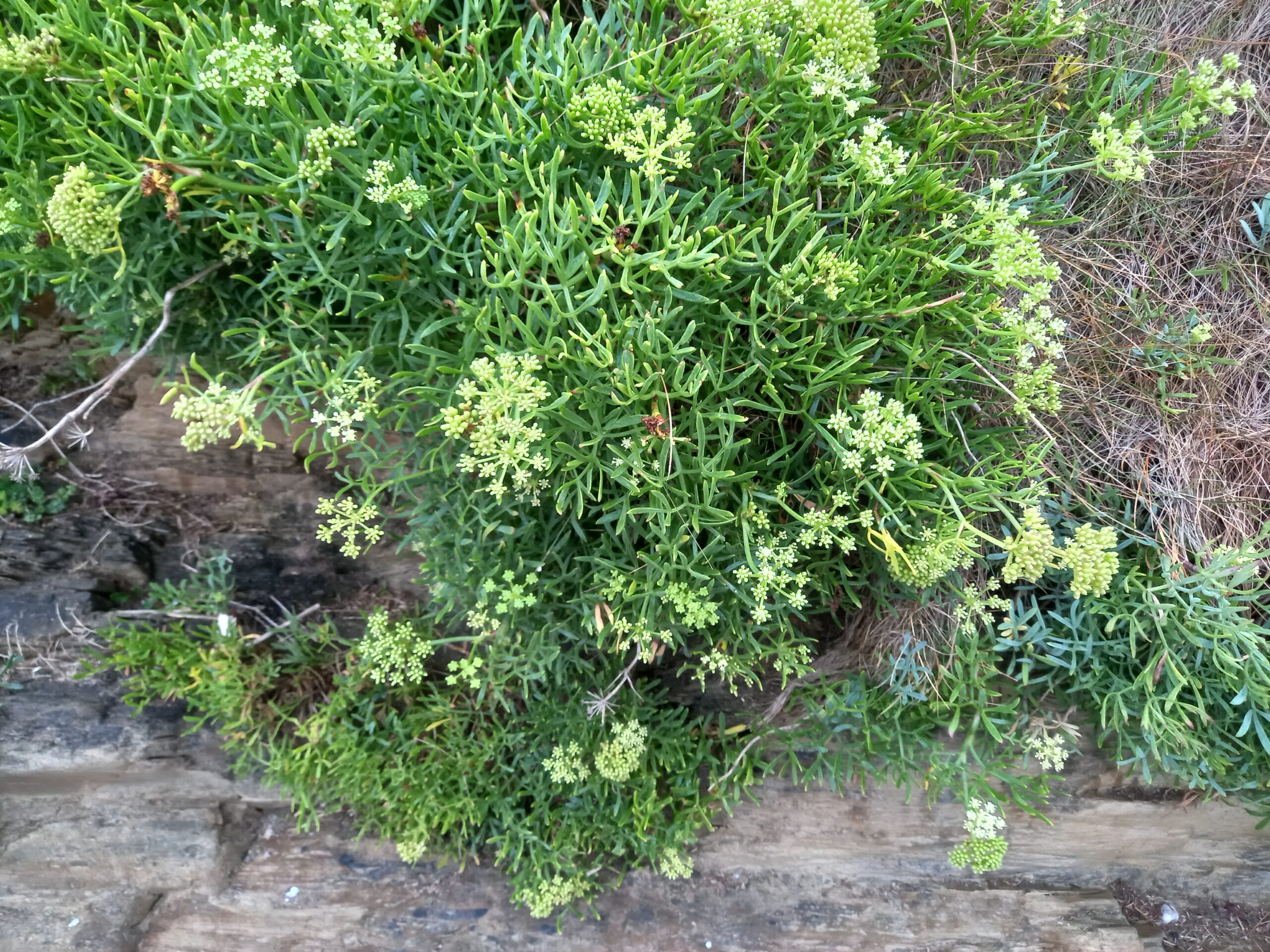
Among the rocks, I found some rock samphire.
It wasn't something I had come looking for. I hadn't made a special journey to Ayrmer Cove to photograph it, and I certainly hadn't expected a small coastal plant to become one of the more memorable parts of the day.
But there it was, growing among the rocks as though it had every right to be there.
Later, I learnt a little more about rock samphire and its remarkable ability to survive in harsh coastal environments. It is adapted to a place where conditions can be difficult, where salt, exposure and the movement of the sea make life rather less comfortable than it might be in a sheltered garden.
I found this fascinating.
We walk past plants and animals every day without giving them much thought. They become part of the background, like the pavement beneath our feet or the clouds above our heads. We notice them when they are particularly colourful, unusually large, or inconveniently placed. Otherwise, we carry on with our lives.
Yet every living organism has its own existence, its own way of surviving in the world. There are struggles and adaptations taking place all around us that we will never witness. A plant growing in a crack in the rocks is doing something remarkable, even if nobody stops to applaud it.
I think there is something rather wonderful about that.
We tend to reserve words like extraordinary for things that are big enough to attract our attention. Great mountains. Violent storms. Vast oceans. Things that make us feel small.
But a small plant holding its ground against the coastal elements deserves a little admiration too.
Perhaps especially because it is small.
Rock samphire will never know that I stopped to look at it. It won't care whether I managed to take a photograph, and it certainly won't be disappointed if I never return. Its life is not a performance for my benefit.
That is probably a good thing. I am not sure I would enjoy being watched every time I tried to do something difficult.
And yet, by stopping to notice it, I learnt something I would otherwise have missed. Not just a little fact about a coastal plant, but a reminder that the world is full of lives that are every bit as real as our own, even when we barely notice them.
There is a great deal happening in the corners of the world we ignore.
Sometimes all it takes to discover it is to look down.
Trying to Catch a Wave
Of course, I had brought my camera for a reason.
The waves were one of the main things I had wanted to photograph at Ayrmer Cove. I was interested in the way they struck the cliffs, the movement of the water, and the contrast between the restless sea and the apparently unmoving rock.
At Whitsand Bay, I had experimented with long exposures to capture the movement of the water in a softer, more blurred way. At Ayrmer Cove, I wanted to try something different.
This time, I used a fast shutter speed of 1/512 second.
The idea was to capture the waves in motion rather than turn them into a smooth, misty shape. I wanted to see the water as something active and forceful, with individual movements held within a fraction of a second.
A wave can look like one enormous thing when you stand on the beach. Through a camera, it becomes a collection of details: the curl of the water, the spray thrown into the air, the foam breaking apart as it strikes the rocks. A fast shutter speed offers a way of examining these fleeting moments before they disappear.
It is a little like asking the sea to hold still for a portrait.
The sea, naturally, does not hold still.
That is part of the challenge, and part of the appeal. Photography involves a curious mixture of control and surrender. You can choose your composition, adjust your settings and decide which moment to capture, but you cannot tell the wave exactly where to break. You have to watch, anticipate and try again.
I generally use the rule of thirds or leading lines when composing my photographs. They are simple techniques, but they work. The rule of thirds can help give a scene balance without making it feel too rigid, while leading lines can guide the viewer's eye through the image. At a location like Ayrmer Cove, the lines of the cliffs, the edge of the water and the shapes of the rocks all offer possibilities.
I also tend to take photographs a little darker than the scene appears to my eyes. This gives me room to bring out details later during editing, rather than trying to capture every possible highlight in the original image.
There is something satisfying about that process. The photograph begins as a record of what I saw, but editing allows me to explore what the image might become. It is not about pretending the place was something it wasn't. At least, that is not what I want to do. It is about finding a way to communicate the atmosphere I experienced and the details I noticed.
The difficulty at Ayrmer Cove was that the conditions were not particularly kind to the camera or the photographer. The light was flat, the wind was strong, and the sea was doing its own thing, as seas tend to do.
But even an uncooperative day can teach you something.
I came away with a better sense of what I might try on a future visit, what compositions might work, and how I could approach the waves differently. Not every photographic trip needs to produce a masterpiece. Sometimes the point is to discover what a place offers, even if the photographs you make that day are only the beginning of a much longer conversation.
Besides, I suspect the sea would be terribly smug if I returned home believing I had conquered it.
A Place Is More Than Its Photographs
Before visiting Ayrmer Cove, I had an idea of what I might find there. I knew there was photographic potential. I had a sense of the coastline and its proximity to Burgh Island, and I imagined the dramatic possibilities of the waves and cliffs.
But knowing about a place is not quite the same as being there.
You can read descriptions on a map or in an online post. You can look at other photographers' images and study the compositions they have chosen. You can learn where to stand, what equipment to bring and which conditions might be most favourable.
All of that is useful.
None of it quite explains what a place feels like.
It doesn't tell you how loud the sea will sound when the waves strike the cliffs. It doesn't tell you which small plant will catch your attention, or what you will think about while watching the water move seaweed from one patch of sand to another. It cannot predict whether you will find yourself thinking about the length of human life while standing beneath a cliff that has existed for longer than anyone can properly imagine.
Those things are part of the experience, even if they never appear in the final photograph.
I think this is one of the reasons photographers return to places they have already visited. The location might be familiar, but the experience is never quite the same. The weather changes. The tide changes. The light falls differently. You notice something you missed the first time, or discover that something you thought was important no longer interests you.
Ayrmer Cove was not at its best for the kind of photography I had hoped to do that day. I would like to return when the weather is better, perhaps when the evening light is softer and the setting sun gives the cliffs a little more character.
A sunset would be lovely.
I am not too proud to admit that I would enjoy having the weather on my side for once.
But I would also like to return because I know there is more to discover. I have already learnt something from the place, and I suspect there are other things waiting among the rocks, the sand and the restless water.
Perhaps I will find another plant. Perhaps the waves will do something extraordinary. Perhaps I will simply spend an hour looking at the cliffs and wondering how many people have stood in that same place, thinking their own private thoughts.
There is no way to know in advance.
That is rather the point.
Things the Sea Forgot to Take
When I think back to Ayrmer Cove, I remember the cliffs first. Then the waves, the seaweed and the rock samphire. I remember the wind, the cloudy sky and the feeling that the day had not quite turned out as I had hoped.
But I also remember the questions.
How long will the cliffs remain after I am gone? What can the arrangement of seaweed tell us about the movement of the world? How many extraordinary lives exist around us without ever being noticed? And what does it mean to photograph a place when the most important things you discover there might never appear in the frame?
I don't have particularly neat answers to these questions. I suspect that neat answers are sometimes overrated.
What I do know is that the trip achieved what I set out to do. It gave me an opportunity to explore a new location, consider its photographic possibilities and experiment with capturing moving water using a faster shutter speed. It also gave me a reason to stop and notice things that I might otherwise have walked past.
The sea will continue to rearrange Ayrmer Cove long after my visit. It will move the seaweed, batter the cliffs and carry away whatever it can persuade to follow it. The rock samphire will continue to grow among the stones, quietly getting on with its own life. And the cliffs will continue their slow conversation with the waves.
I will return home with my photographs, which are small records of a place at a particular moment. They will not contain everything I saw, and they certainly won't contain everything I thought. A camera is a useful thing, but it cannot photograph an idea, or the feeling of suddenly understanding that the world is full of lives and histories that have nothing to do with you.
Perhaps that is why I like photography.
It gives me an excuse to go somewhere and look closely. To stand still when I might otherwise hurry past. To notice the strange arrangements of ordinary things and wonder why they have ended up that way. Sometimes it gives me a beautiful image. Sometimes it gives me a disappointing one. And sometimes it gives me a question that follows me home.
Perhaps the point of wandering around with a camera isn't always to come home with something extraordinary.
Sometimes it is simply to pay attention to a place long enough to discover that the ordinary things were rather extraordinary all along.
And perhaps, if we are very lucky, we might find a few things the sea forgot to take.